Canvas tarpaulin is a strong and versatile covering material used for construction, transportation, agriculture, outdoor storage, camping, and industrial applications. Because canvas is made from tightly woven fabric, it can handle considerable stress when properly selected and installed.
However, there is no single weight limit for all canvas tarpaulins. The amount of weight a canvas tarpaulin can withstand depends on its material, thickness, size, construction, condition, and how the weight is distributed.
Understanding these factors can help you choose the right canvas tarpaulin for your application and prevent unnecessary damage.
What Determines the Weight Capacity of Canvas Tarpaulin?
Several factors affect how much weight a canvas tarpaulin can handle.
1. Canvas Material
The type of fiber used in the canvas has a major effect on its strength. Cotton canvas, polyester canvas, and blended fabrics can have different tensile-strength characteristics.
A high-quality, tightly woven canvas generally provides better resistance to tearing and stretching than a lightweight fabric.
2. Fabric Weight and Thickness
Heavier canvas is generally stronger than lightweight canvas, although fabric weight alone does not determine its maximum load.
Manufacturers may describe canvas using fabric weight, thickness, or other specifications. A heavier tarpaulin is often better suited to demanding applications.
3. Tarpaulin Size
The overall size of the tarpaulin can affect how forces are distributed.
A large sheet may experience greater stress when exposed to wind, especially if it is stretched tightly or attached at multiple points. Therefore, simply knowing the material’s weight is not enough to determine how much load the entire sheet can safely support.
4. Grommets and Attachment Points
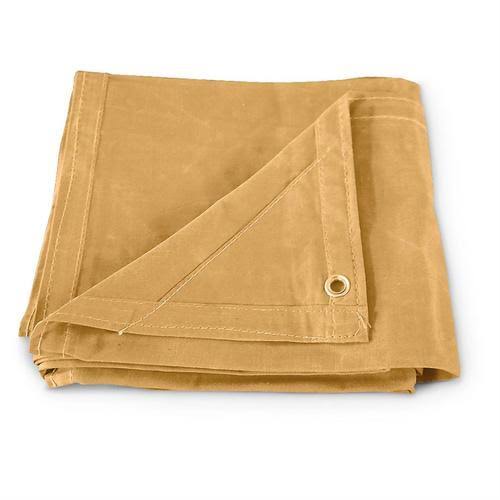
The grommets, ropes, straps, hooks, and other attachment points can become the weakest parts of a tarpaulin system.
Even a strong canvas sheet can tear if too much force is concentrated around a single grommet.
5. Weight Distribution
A canvas tarpaulin can handle distributed pressure differently from a concentrated load.
For example, placing a broad, evenly distributed load across a properly supported surface is very different from hanging a heavy object from one small point.
Canvas tarpaulin should not be treated as a lifting sling or load-bearing platform unless it has been specifically designed and rated for that purpose.
How Much Weight Can a Canvas Tarpaulin Hold?
There is no universal figure such as “100 kg” or “500 kg” that applies to every canvas tarpaulin.
A manufacturer’s rated tensile strength, tear strength, puncture resistance, and safe working load, if provided, should be used instead.
For ordinary canvas tarpaulins, it is safer to think of the material primarily as a protective covering rather than a load-bearing product.
For example, a canvas sheet can cover equipment, goods, building materials, or outdoor items without necessarily supporting their weight. If a heavy object is placed directly on the sheet, the pressure may damage the fabric even when the material itself feels strong.
Can You Put Heavy Objects on Canvas Tarpaulin?
You can use canvas tarpaulin underneath or over heavy objects for protection, but you should avoid placing excessive concentrated weight directly on the fabric.
Heavy objects can cause:
- Stretching
- Tearing
- Punctures
- Damaged seams
- Grommet failure
- Permanent deformation
- Abrasion
If a tarpaulin is being used as a ground cover, placing a protective layer underneath sharp or rough objects can reduce the chance